
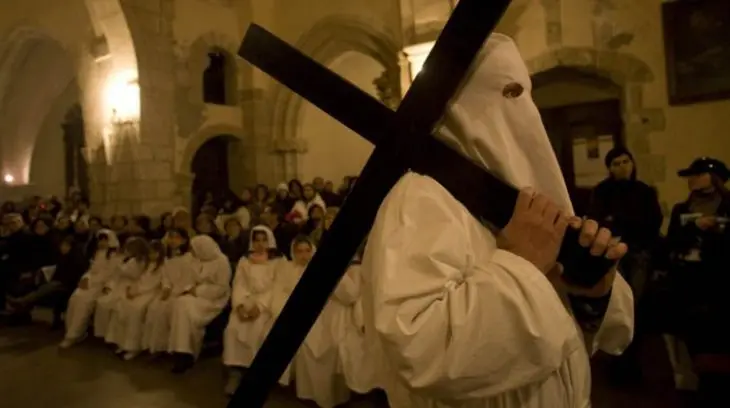
The Easter atmosphere in Sardinia: a blend of spirituality, ancient traditions, and lively festivities.
Evocative moments governed by centuries-old customs—rituals echoing their Spanish roots, charm, and mystery—combine with events, concerts, exhibitions, festivals, and tastings, drawing large crowds of locals and visitors to the streets and squares of towns and villages alike. Throughout Holy Week—from Palm Sunday to the Easter S’Incontru (The Meeting), and continuing from Easter Monday through the long weekends of late April and early May—Sardinia is filled with a unique blend of atmosphere and emotion: the profound devotion and intimate spirituality of the Easter rites give way to the vibrant energy of communities preserving deeply rooted traditions.
Sassari is one of the places that preserves customs derived from Iberian traditions; in this “capital” of northern Sardinia, the rites begin on Holy Tuesday with the Procession of the Mysteries. Holy Thursday sees the Sepolcri (Altars of Repose) welcoming thousands of the faithful, while Good Friday evening marks the s’Iscravamentu (the Deposition). On Sunday, April 5th, the Easter S’Incontru takes place in Piazza Colonna Mariana. Alghero’s Holy Week blends Catalan and Sardinian rites. Key highlights include the cerques (processions through the historic center) and the moving, dramatic Desclavament—the Deposition from the Cross—on the evening of Friday the 3rd. Three days define the observance in Castelsardo: the Monday following Palm Sunday (Lu Lunissanti), Thursday (La Prucissioni), and Friday’s Lu Ilcravamentu. A standout event is the Lunissanti procession of Choirs and Mysteries, scheduled for Monday, March 30th, which makes its way to the church of Nostra Signora di Tergu. In Aggius, Holy Week unfolds through night-time processions and rituals marked by the voices of the Tasgja (a choral singing tradition from Upper Gallura), as well as Su Sgraamentu on Good Friday and S’Intoppu, the Easter encounter. Also in the Gallura region, the Santa Teresa Gallura Easter Festival and the Easter Monday concert in Arzachena take place.
Gosos (traditional religious hymns) provide the soundtrack for the rituals in Bosa: on Tuesday, March 31, statues representing the Misterios (Mysteries of the Passion) are paraded in procession; the sas Chilcas procession takes place on Thursday, April 2; and the highlight, S’Iscravamentu (the Deposition from the Cross), occurs the following day. Staying in the west, the Is Misterius procession and Su Scravamentu mark the climax of Holy Week in Oristano. In the “City of Eleonora,” the Procession of the Mysteries takes place on Holy Monday, while visits to the altars of repose and the Deposition rites occur on Thursday and Friday—the latter also featuring the poignant S’Interru (Burial) procession. Good Friday hosts the most moving moments of Holy Week in Cuglieri, which also trace their roots to the Middle Ages: the morning of April 3 features the s’Ingravamentu ritual (the Crucifixion), followed by the carrying of the cross into the Basilica of Santa Maria della Neve. In the afternoon, processions and rituals are accompanied by evocative devotional songs. Cuncordu singing also plays a central role in the rich schedule of events in Santu Lussurgiu, particularly on Thursday the 2nd during the S’Incravamentu ritual and on Good Friday for S’Iscravamentu. This journey through distinctive Easter rites begins in the Baronia region—specifically in Galtellì, where rituals of Spanish origin have been handed down for centuries by the town’s two confraternities, Santa Rughe (1614) and Sas Animas (1729)—before moving to Barbagia. In Desulo, the Prioresse (female priors) take center stage, responsible for overseeing preparations and festivities. The Palm Sunday procession—starting at 10:00 AM on March 29—is not to be missed; it is a riot of color thanks to the striking styles of the traditional costumes. The celebrations in Desulo are complemented by those in Tonara, where Easter Monday is a culinary affair featuring the Nougat Festival (Sagra del Torrone). Speaking of celebrations, in the shadow of Mount Corrasi, Easter is marked by a joyous collective outpouring: Oliena hosts S’Incontru (The Meeting), one of the island’s most beautiful rituals.
Holy Week in Cagliari unfolds across its four historic districts. The Processions of the Mysteries take place in Villanova and Stampace on Friday, March 27, and Tuesday, March 31; Thursday, April 2, marks the Rite of the Seven Churches; Friday sees the moving entry of the crucified Jesus into the Cathedral; and Saturday, April 4, features Su Scravamentu (The Deposition) in the Church of San Lucifero in the morning, followed in the evening by a procession, vigil, and the entry of the Risen Christ into the Church of San Giacomo. The program in Iglesias, established centuries ago, retains an aura of charm and mystery surrounding its processions: the Mysteries (Tuesday the 31st), Our Lady of Sorrows (Addolorata, Thursday the 2nd), and the Mount (Monte) and the Descent (Descenso, Friday the 3rd). The final two days are characterized by the historic streets being filled with baballottis—spectral, white-clad figures. The calendar also extends to the Parteolla and Marmilla regions, with rites scheduled in Dolianova—centered around the majestic former cathedral of San Pantaleo—and in Segariu, where Easter is welcomed by the festive ritual of the Fucilieri.